

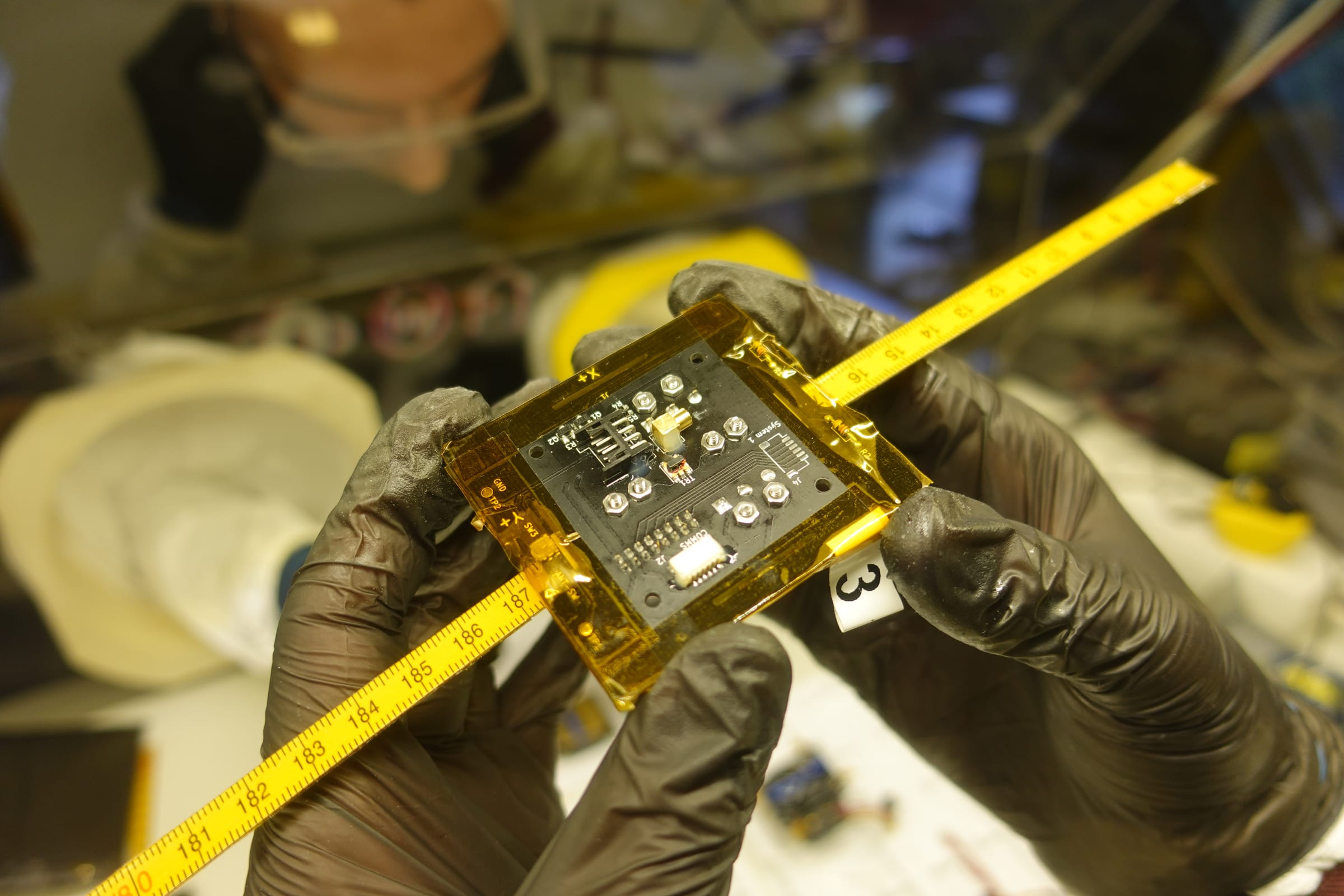
QUBIK is LSF’s series of 1P PocketQube picosatellites (5×5×5 cm, ~200 g — form factor confirmed on Gunter’s Space Page) built as a reusable, fully open platform for Launch and Early Operations Phase (LEOP) identification, Doppler-based orbit determination and amateur-radio experiments. Five units have flown to date and the bus has been adopted by downstream missions including ERMINAZ.
What LSF does
LSF designs and develops the full QUBIK bus — structure, EPS with deployable solar panels, UHF COMMS, OBC and flight software — alongside the ground-segment flowgraphs and identification/tracking algorithms that let the global SatNOGS network participate in each LEOP campaign. All hardware and software is published openly at gitlab.com/librespacefoundation/qubik with documentation at qubik.libre.space.
Where we’re going
QUBIK validates that distributed, crowd-sourced radio-ranging can identify and track small satellites immediately after deployment, feeding into Space Situational Awareness work now embodied in SIDLOC and PHASMA. The platform is intentionally reusable so every new launch opportunity reproduces the same open-source bus with refined payloads — and the QUBIK bus has already been adopted by AMSAT-DL for the ERMINAZ satellites.
Where the project stands
QUBIK-1 / -2 were lost on Firefly Alpha FLTA001 (2021-09-03, COSPAR 2021-F08) when the launch vehicle failed on ascent. QUBIK-3 / -4 flew on FLTA002 ‘To The Black’ (2022-10-01, COSPAR 2022-122#), deployed from PICOBUS, operated for two days on 435.240 MHz (GFSK/BPSK at 9600 baud) and re-entered on 2022-10-03 as predicted. NIS-PQ (QUBIK-5), built for a Nazarbayev Intellectual School in Astana, Kazakhstan, launched on SpaceX Falcon 9 Transporter-18 on 2026-10-01 and was deployed from PICOBUS v2 on board UARX Space’s OSSIE-D into a ~515 km sun-synchronous orbit and is downlinking telemetry on 435.240 MHz, received by the SatNOGS network since 2026-10-04.
Milestones
- 2019-12 — QUBIK mission announced (with PICOBUS, on the Firefly Alpha DREAM manifest)
- 2020-11 — QUBIK-1 / -2 flight-ready; integrated into PICOBUS
- 2021-09-03 — QUBIK-1 / -2 lost on Firefly Alpha maiden flight (FLTA001)
- 2022-10-01 — QUBIK-3 / -4 launched on FLTA002 ‘To The Black’, deployed via PICOBUS
- 2022-10-03 — QUBIK-3 / -4 re-entered as planned after ~2 days of operations
- 2026-10-01 — NIS-PQ (QUBIK-5) launched on SpaceX Falcon 9 Transporter-18; first signals received by SatNOGS on 2026-10-04
Links
- Project page
- Repository
- Documentation
- SatNOGS DB — QUBIK-3
- SatNOGS DB — QUBIK-4
- Gunter’s Space Page — QUBIK 1–6
License
Hardware: CERN-OHL-S v2; Software: GPL-3.0